

Guide to Susan B. Anthony Dollars
The Susan B. Anthony Dollar represented the first modern small-sized dollar coin series released by the United States Mint. The previous Eisenhower Dollar series, which had been produced with the same diameter as classic silver dollars, had seen limited usefulness in commerce due to its size and weight. The format for the new series was developed to directly address these perceived problems and concerted efforts were made to promote use of the coins within circulation. Unfortunately, the general public did not embrace the new format, and the coins were issued for only three years from 1979 to 1981 and one final year in 1999. Nonetheless, the Susan B. Anthony Dollars represented an important transformational step for the highest circulating denomination within contemporary American coinage.
Legislation
The authorizing legislation for the series was passed by Congress on September 26, 1978 and signed into law by President Jimmy Carter on October 10, 1978. At the first strike ceremony on December 13, 1978, Mint Director Stella B. Hackel highlighted the fact that the size and weight were selected so that the new coins would be convenient and easy to use. The copper-nickel composition pieces were sized between the quarter and half dollar and weighed one-third as much as four quarters. The coins had an 11-sided inner border, which would allow the coins to be differentiated by touch. If widespread circulation took place, there would be potential cost savings to the government, since the coins had a significantly longer expected lifespan than the dollar bill.
Design
United States Mint Chief Engraver Frank Gasparro had begun the process of creating designs for the new series before legislation had even passed. His initial designs featured a modern depiction of Liberty on the obverse and a soaring eagle on the reverse. This design had received the support of the Commission of Fine Arts and the Treasury Department, however the legislation introduced by Congress called for a design featuring social reformer Susan B. Anthony. This would represent the first time that the likeness of an actual woman appeared on circulating United States coinage.
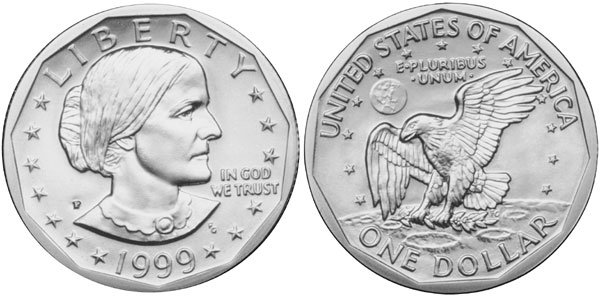
Gasparro turned his attention to creating a design depicting Anthony, referencing six different images. The final reverse design featured a right-facing portrait of Susan B. Anthony primarily based on a plate that appeared in the book History of Woman Suffrage written by Elizabeth Caddy Stanton. The word “LIBERTY” appears above the portrait with thirteen stars surrounding, configured seven to the right and six to the left. The motto “IN GOD WE TRUST” is in the right field and the date is below.
Initially, Gasparro hoped that his newly created soaring eagle design could be used for the reverse of the coin, however the legislation passed by Congress called for maintaining the reverse design from the previous series. The design was based on the Apollo 11 mission insignia and features an eagle landing on the moon with an olive branch in its claws. Thirteen stars circle the eagle, and the earth as seen from the space appears in the background. The inscription “UNITED STATES OF AMERICA” appears above, with “E PLURIBUS UNUM” below. The denomination, indicated as “ONE DOLLAR”, is covering the lower part of the moon.
Production
Production for circulation took place in large numbers for the first year of issue in 1979 based on anticipated widespread use in commerce. Despite promotional efforts on behalf of the United States Mint, the new small-sized dollar coins failed to gain traction within circulation. Many found the coins to be too easily confused with the quarter due to the similar size, and most people were more familiar with the paper dollars which continued to circulate. Production would decline in the following year, and by 1981 the coins were only struck for inclusion within annual collector sets.
After an 18-year hiatus, the coins would be struck again in 1999. This represented the longest gap in production for a U.S. coin series in history, exceeding the 17-year gap that had occurred for the Morgan Dollars. According to the United States Mint, this unusual move was necessary to ensure the availability of dollar coins for circulation until the launch of the Sacagawea Dollar in the following year. Apparently, the entire stockpile of dollar coins that had been produced in 1979 and 1980 had finally been exhausted due to increased demand from mass transit authorities and vending operations. The 1999 Susan B. Anthony Dollars would be struck both for circulation and collectors, representing the unexpected final year of the series.